How Pyrolysis Technology Works
Understanding the science behind converting industrial waste into international standard diesel, carbon black, and steel. Batch and continuous operation.
THE SCIENCE
What Is Pyrolysis?
Pyrolysis is the thermal decomposition of organic materials at elevated temperatures (380-400°C) in the absence of oxygen. When applied to waste materials like tyres, plastic, rubber, and oil, the polymers break down into valuable products: fuel oil, carbon black, and steel wire.
This is not incineration — the oxygen-free environment prevents combustion and instead produces clean, recoverable hydrocarbons. The fuel oil can then be further refined through distillation into international standard diesel, suitable for trucks, generators, and industrial applications.
Jinzhen offers both batch and continuous operation modes, allowing flexibility for different project scales and requirements. Our technology is always being updated to deliver the best results.
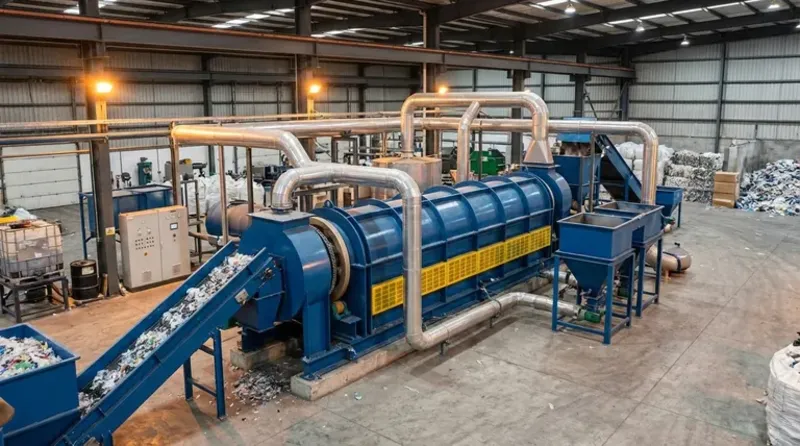
Watch Our Technology at Work
Two Operation Modes Available
Choose the operation mode that suits your project scale and requirements.
Batch Operation
- • Ideal for smaller-scale operations
- • Lower initial investment
- • Flexible scheduling
- • Simpler operation and maintenance
- • Perfect for market entry
Continuous Operation
- • 24/7 non-stop processing
- • Maximum throughput and efficiency
- • PLC touchscreen automated control
- • Only 1-3 operators per shift
- • Ideal for large-scale commercial plants
The Complete Process: Step by Step
Pre-Treatment
Waste materials — tyres, plastic, rubber, medical waste, or oil — are prepared for processing. The JF-610 pre-treatment system handles shredding for solid waste, increasing surface area for efficient reactor processing.
The system can handle whole tyres and various solid waste types, reducing them to optimal size for the feeding system.
Pyrolysis (Thermal Decomposition)
Material enters the reactor where it is heated to 380-400°C in an oxygen-free environment. Polymers break down into hydrocarbon vapours. Available in both batch and continuous operation modes.
The 15CrMo alloy reactor operates with PLC-controlled temperature and rotation. Batch mode suits smaller operations; continuous mode enables 24/7 processing.
Condensation & Oil Recovery
Hot hydrocarbon vapours pass through the condensing system, where they cool and convert to liquid fuel oil. Non-condensable gases are recycled as heating fuel.
The integrated condensing system maximizes oil recovery. The self-sustaining gas cycle reduces external fuel costs significantly.
Distillation (Oil to Diesel)
Pyrolysis oil enters the distillation unit, converting it to international standard diesel through catalytic processing with an 80-90% yield.
The distillation unit operates continuously with zero chemical discharge. The catalyst lasts 2 years, and the system runs on self-produced waste gas after initial startup.
By-Product Recovery
Carbon black is cooled, collected, and processed into activated carbon briquettes. Steel wire is magnetically separated for scrap sale. All mass is converted to valuable products.
Zero waste to landfill — all feedstock mass is converted to valuable products or self-consumed energy.
Emissions Treatment
The YQCL-6W environmental system treats all flue gases through 6 stages: cooling, dual desulphurization, denitrification, dehydration, and activated carbon adsorption.
Achieves ≤10 mg/m³ particulates, ≤50 mg/m³ SO₂, ≤100 mg/m³ NOx — well below most national standards.
Output Products & Yields
All feedstock mass converted to valuable products or self-consumed energy. Zero waste.
45%
Heavy Fuel Oil
Converted to diesel via distillation
40%
Carbon Black
Processed into activated carbon briquettes
10%
Steel Wire
Sold as scrap metal
5%
Syn-Gas
Recycled as heating fuel (self-sustaining)
Training & Local Engineering Support
Operator Training
Jinzhen provides comprehensive on-site training for all plant operators during installation and commissioning.
Local Engineering
Local engineering support available for ongoing maintenance, troubleshooting, and equipment optimization.
Always Updating
We continuously update our technology to deliver improved efficiency, lower emissions, and better output quality.